
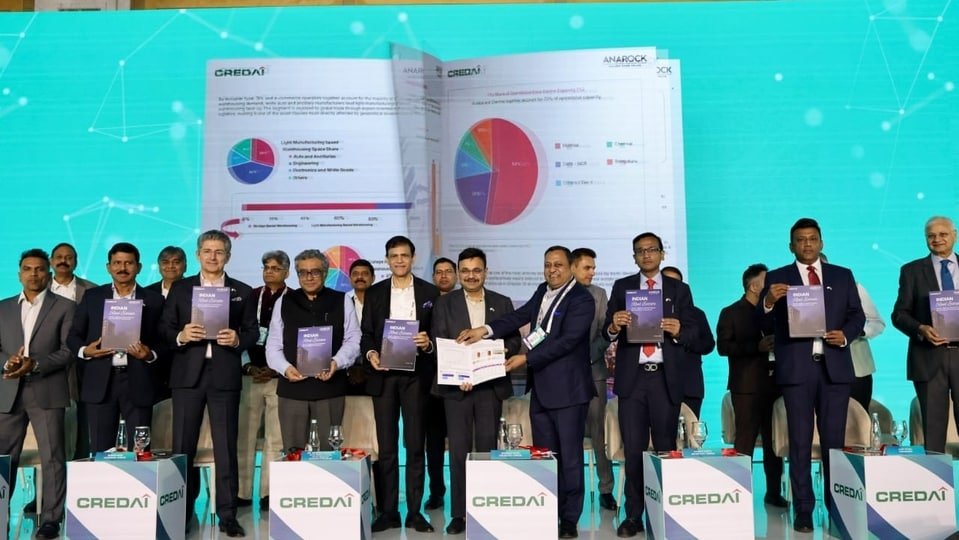
India’s real estate sector is entering its next major growth phase, with the market projected to expand from approximately $600 billion in 2025 to $1 trillion by 2030 and nearly $5.8 trillion by 2047, according to a joint report by CREDAI and ANAROCK Research & Advisory.
The findings, presented at CREDAI’s NATCON 2026 in Kolkata, point to a sector that has moved considerably beyond its traditional residential and metropolitan core. Rising housing demand, expanding office markets, stronger construction activity, emerging cities and technology adoption are collectively reshaping the Indian real estate market.
The report, titled Indian Real Estate: Growth Trajectory, Sectoral Outlook and Geopolitical Crosscurrents, also highlights the growing economic weight of real estate. The sector’s contribution to India’s GDP is projected to increase from 6% in 2017 to around 13% by 2030, while employment in the sector could reach approximately 30 million people by the end of the decade.
From a $120 Billion Market to a $1 Trillion Opportunity
India’s real estate market has expanded fivefold in less than a decade.
The sector was valued at around $120 billion in 2017. By 2025, that figure had climbed to approximately $600 billion. If the projected trajectory holds, the market could cross the $1 trillion mark by 2030 and approach $5.8 trillion by 2047.
That trajectory reflects more than rising property prices. It represents the expansion of the underlying real estate ecosystem, including housing, offices, retail, warehousing and other emerging asset classes.
CREDAI National President Shekhar G. Patel said the sector’s growth mirrors India’s broader economic transformation and highlighted its potential to become a significantly larger contributor to the country’s economy.
Real Estate’s Economic Contribution Is Set to Rise
The projected increase in GDP contribution is particularly significant.
According to the report, real estate could account for approximately 13% of India’s GDP by 2030, compared with 6% in 2017.
At the same time, employment generated by the sector is expected to reach around 3 crore people.
The numbers underline the fact that real estate’s economic impact extends well beyond developers and homebuyers. Construction, finance, building materials, professional services, infrastructure, logistics and a wide network of allied industries are all connected to the sector’s expansion.
Construction Pipeline Surges to $503 Billion
One of the clearest indicators of the sector’s expansion is the value of real estate currently under construction.
Across residential, office, retail and warehousing, the value of projects under construction increased from just $94 billion in 2009 to $503 billion in 2025.
That represents more than a fivefold increase over the period.
But the composition of this pipeline has changed dramatically.
Residential projects accounted for approximately 48% of the total construction value in 2009. By 2025, their share had risen to 85%.
Housing Construction Has Become the Biggest Growth Engine
The value of housing projects under construction reached approximately $430 billion in 2025, compared with:
- $45 billion in 2009
- $235 billion in 2019
- $430 billion in 2025
The near-doubling between 2019 and 2025 reflects the sharp increase in residential construction following the Covid-19 pandemic and the sustained demand for housing that followed.
Residential real estate has therefore emerged as the dominant component of India’s construction pipeline, even as commercial asset classes continue to expand from a smaller base.
Residential Demand Remains Strong Across Major Cities
The housing market has also recorded a substantial increase in sales value.
Across India’s top seven cities, annual residential sales value rose from ₹2.35 lakh crore in FY22 to ₹6.10 lakh crore in FY26, according to the CREDAI-ANAROCK findings.
The market has also maintained a strong quarterly run. Residential sales value remained above ₹1.3 lakh crore for seven consecutive quarters.
This sustained performance suggests that housing demand has remained resilient despite changing economic conditions and wider geopolitical uncertainty.
Rising Sales Value Points to Higher-Ticket Housing
The increase in sales value has been considerably faster than the growth in unit volumes.
That distinction matters.
A larger sales value does not necessarily mean that significantly more homes are being sold. It can also reflect a shift in buyer preferences towards larger, better-located and higher-priced homes.
The data therefore points towards continued premiumisation within India’s residential market, with developers increasingly responding to demand for higher-value housing.
Commercial Real Estate Holds Its Ground
Residential may account for the largest share of the construction pipeline, but commercial real estate continues to demonstrate strong underlying demand.
The office market, particularly the Grade A segment, has remained resilient.
A major source of this demand is the continued expansion of Global Capability Centres (GCCs).
GCCs accounted for approximately 45% of total office leasing during H1 2026, highlighting their growing importance to India’s commercial real estate market.
Their expansion is closely linked to India’s position as a major destination for global companies establishing technology, engineering, analytics, finance and other specialised operations.
Office REITs Continue to Scale
The institutionalisation of commercial real estate is also becoming more visible through the growth of listed office REITs.
According to the report, the combined leasable area represented by listed office REITs has increased nearly sixfold since FY19.
The expansion reflects the increasing maturity of India’s income-generating commercial property market and provides institutional and retail investors with greater access to professionally managed real estate assets.
The Next Growth Story May Come From Beyond the Metros
India’s real estate expansion is no longer limited to Mumbai, Delhi-NCR, Bengaluru, Hyderabad, Chennai, Pune and Kolkata.
Tier-2 and Tier-3 cities are increasingly becoming important growth centres.
Improving infrastructure, better connectivity, rising incomes and the decentralisation of businesses are creating conditions for real estate development beyond the established metropolitan markets.
This shift could produce a more distributed growth model, where smaller cities increasingly contribute to housing, commercial development and investment activity.
Emerging Asset Classes Are Broadening the Market
The real estate ecosystem is also becoming more diverse.
Beyond conventional residential and office assets, the report identifies areas such as:
- Data centres
- Warehousing
- Hospitality
- Retail
- Commercial real estate
as important components of the sector’s expanding landscape.
These segments are being supported by structural changes in consumption, technology, logistics, business operations and urbanisation.
The implication for developers and investors is clear: India’s real estate opportunity is becoming increasingly multi-dimensional.
AI Is Changing How Real Estate Gets Built and Sold
Technology is becoming another major force shaping the sector.
Artificial intelligence is gradually moving into different stages of the real estate value chain, from market intelligence and customer engagement to project planning, construction monitoring, decision-making and operational management.
CREDAI National President Shekhar G. Patel emphasised that technology adoption should go beyond simply introducing new tools.
The larger opportunity lies in using technology to improve productivity, transparency, decision-making and responsiveness across the business.
For developers, this could mean more data-driven project planning. For customers, it could translate into more personalised engagement. For construction teams, AI-led monitoring and analytics could improve execution and operational efficiency.
The technology layer is therefore becoming increasingly difficult to separate from the physical real estate business.
Kolkata Becomes the Stage for India’s Next Real Estate Conversation
The findings were unveiled during NATCON 2026 in Kolkata, CREDAI’s flagship annual convention, which brought together developers, investors, policymakers and financial experts.
The choice of Kolkata also carried a broader message.
West Bengal Finance Minister Dr Swapan Dasgupta highlighted the development opportunities in Kolkata and West Bengal, while calling for the removal of barriers such as the Urban Land Ceiling restrictions.
He also invited developers and investors to participate in the state’s next phase of development.
The focus reflects a wider industry conversation around how infrastructure, policy reform and real estate development can work together to create more competitive urban markets.
Growth Will Depend on Skills as Much as Technology
Technology alone cannot carry the sector into its next phase.
The industry is also facing a significant requirement for skilled construction workers.
The CREDAI CSR Foundation and Tata Capital Housing Finance have partnered to train approximately 1,250 construction workers, as part of CREDAI’s broader target of training 50,000 construction workers during the current financial year.
The initiative recognises a practical reality: new construction technologies are useful only when the workforce has the skills required to deploy them effectively.
What the $1 Trillion Projection Really Means
The projected $1 trillion market size is not simply a larger number attached to the Indian property market.
It signals a structural expansion of the sector.
Housing demand remains robust. Commercial office markets continue to attract occupiers. GCCs are strengthening India’s position in global business services. REITs are deepening institutional participation. Warehousing and data centres are creating new demand pools. Meanwhile, Tier-2 and Tier-3 cities are becoming increasingly relevant to the country’s urban growth story.
The sector is also becoming more technology-driven, while skill development and sustainability are emerging as important complements to physical construction.
India’s Real Estate Market Is Entering a Larger, More Diverse Cycle
The path from $600 billion in 2025 to $1 trillion by 2030 will require sustained demand, continued infrastructure investment, stronger execution and an ability to respond to changing consumer and business requirements.
The CREDAI-ANAROCK report suggests that the foundations for this expansion are already visible.
Residential real estate remains the largest component of the market. Commercial property continues to attract strong occupier demand. Emerging cities are widening the geography of opportunity, while technology is changing how projects are planned, marketed, built and managed.
If these trends continue to reinforce one another, India’s real estate sector could become not only a $1 trillion market by 2030, but an increasingly important engine of urbanisation, employment and economic growth over the decades that follow.